


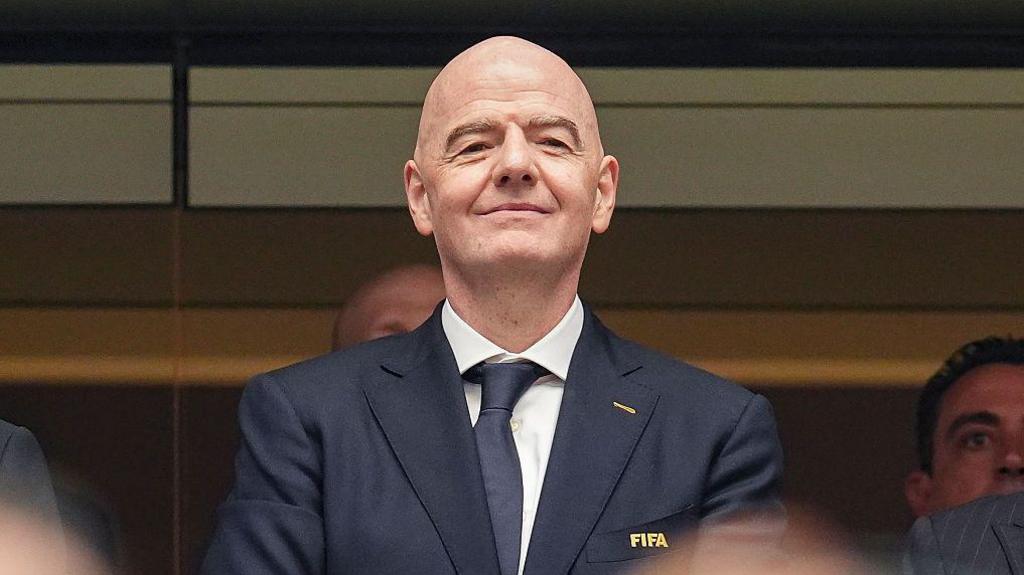
FIFA has officially responded to threats from UEFA and European football associations to boycott its competitions—including the World Cup—if President Gianni Infantino proceeds with a controversial plan to allow private investors into the entity managing FIFA’s commercial rights.
The global governing body insisted it will proceed with consultations regarding the project, strongly denying accusations that it is attempting to “sell the World Cup” or relinquish ownership of football to external investors.
UEFA Statement and World Cup Boycott Threat
Following an emergency meeting featuring all 55 European member associations, UEFA unanimously rejected FIFA’s proposal to sell equity stakes in the World Cup and other tournaments to private investors.
European football’s governing body declared that its national teams will not participate in any FIFA-organized tournament as long as the proposal remains on the table. UEFA demanded the plan be scrapped entirely, alongside binding guarantees that ownership of football competitions will never be opened to private investors in the future.
UEFA slammed the presentation of the plan as an attempt to force national associations to choose between accepting the proposal or forfeiting substantial funding, describing the approach as “governance by intimidation” rather than a democratic process.
The boycott threat applies across all FIFA competitions, starting from the FIFA U-20 Women’s World Cup in Poland this September, up to the 2027 Women’s World Cup and the 2030 Men’s World Cup.
FIFA’s Reply: A Direct Challenge to UEFA
In its official statement, FIFA acknowledged the concerns raised by continental governing bodies but claimed that inaccurate media reports had derailed the consultation process it intended to conduct with its members.
“Nobody is selling football, and that is something FIFA would never consider,” the statement read, reassuring stakeholders that the initiative would not compromise the spirit or governance of the sport.
However, the sharpest part of FIFA’s response came when it asserted that no single organization has the right to claim it represents all 211 member associations. This remark was widely interpreted as a direct challenge to UEFA and an attempt to engage directly with individual European nations.
FIFA emphasized that it will continue the consultation process so that every national association can vote based on complete information, while acknowledging that the proposed entity—FIFA Forward Enterprise—will not move forward without explicit member approval.
Roots of the Conflict and Global Backlash
The crisis erupted after Infantino proposed creating FIFA Forward Enterprise, a new commercial arm designed to manage rights for the World Cup and other global tournaments.
Under the plan, the new company would be valued at approximately $20 billion, with a 20% stake sold to private investors for around $4 billion. In exchange, national associations were promised increased funding if the proposal was approved.
Opponents fear that bringing in private equity could subject tournament scheduling, team expansion, and competition formats to profit-driven pressures, further congesting the international match calendar and undermining continental and club competitions.
Resistance extends beyond Europe. CONCACAF has rejected the proposal, while the president of the Asian Football Confederation (AFC) warned of its potential damage to continental tournaments.
Furthermore, European governmental bodies and the European Commission have voiced strong opposition, whereas CONMEBOL has refrained from taking a firm stance, and the Confederation of African Football (CAF) stated it is currently reviewing the plan.