


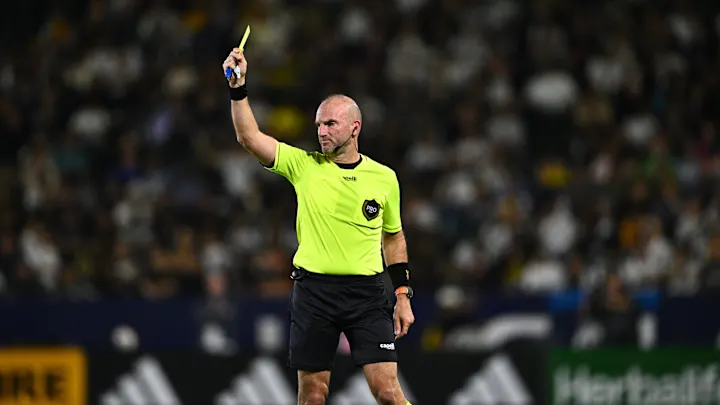
The BBC has revealed that FIFA is planning a historic decision for the 2026 World Cup regarding suspension rules stemming from accumulated yellow cards during the tournament, which will be held in the United States, Canada, and Mexico.
Under current rules, a team plays five matches to reach the quarterfinals, and receiving two yellow cards during these matches results in an automatic suspension.
Historically, there has been one amnesty period throughout the tournament, which comes in the quarterfinals when all yellow cards accumulated by players during the group stage and the round of 16 are cleared.
However, with the new World Cup format, which will feature 48 teams instead of 32, an additional round will be added, creating a sense that the risk of suspension has become significantly higher.
FIFA is currently considering changing this rule by adding another amnesty period after the group stage, during which yellow cards from the first three matches would be cleared, giving players a greater chance to participate in the knockout rounds without worry.
FIFA fears that without changing the rules, a significantly larger number of players will find themselves facing suspension after playing six matches up to the quarter-finals, potentially depriving several key players of participating in the semi-finals.
FIFA believes that a two-stage “clearing” of yellow cards is a fairer solution and less likely to cause absences in crucial matches compared to raising the number of yellow cards required for a suspension to three.
This issue is scheduled to be discussed when the FIFA Council meets in Vancouver, Canada, on Tuesday. While two yellow cards will remain the threshold for a suspension, the proposed change would mean only two short periods within which a player can receive a suspension.