

The Senegalese Football Federation (FSF) finds itself in an escalating crisis following its decision to dismiss Pape Thiaw as head coach of the Teranga Lions. The move has hit a major obstacle after the Senegalese government declined to fund the financial obligations tied to his contract—raising the unexpected possibility that Thiaw could remain in charge despite the initiation of termination proceedings.
The FSF initially resolved to part ways with Thiaw and his staff following a review of Senegal’s performance at the 2026 FIFA World Cup, citing a “breakdown of trust” and the need for a fresh tactical direction. However, executing this decision has been blocked by the Ministry of Youth and Sports.
Ministry Denies Contract Approval
According to a report by Foot Mercato, Sports Minister Djéri Clotilde Coly officially notified the FSF that the agreement signed with Thiaw on June 22, 2026, in New Jersey never received formal state approval—even though the ministry was expected to cover his compensation.
While acknowledging the federation’s desire to extend Thiaw’s tenure, the Minister emphasized that public funds cannot be allocated to cover salaries or financial clauses for an unapproved contract.
The disputed deal includes:
-
Monthly Salary: 30 million CFA francs (~$54,000 USD).
-
Signing Bonus: 120 million CFA francs (~$217,000 USD).
-
Performance Bonus: A 1% share of FIFA’s total prize money awarded to Senegal for its World Cup participation.
The root of the conflict dates back to February 2026, when Thiaw’s initial contract expired, leaving him working for several months without pay. Hours before Senegal’s World Cup clash against Norway, Thiaw’s representatives threatened that he would not take the bench without a signed extension. The FSF swiftly executed the agreement without securing prior government authorization.
Dressing Room Tension and Internal Disputes
Financial hurdles are not the sole reason for the rift. FSF President Abdoulaye Fall accused Thiaw of making key decisions without consulting the Technical Director, refusing performance targets in his contract, and overseeing internal squad friction. Thiaw maintained that his actions were a matter of “principle and respect” rather than financial leverage.
Tensions have also surfaced among senior squad members:
-
Pape Gueye publicly stated he would not represent the national team as long as the current coaching staff remained in charge.
-
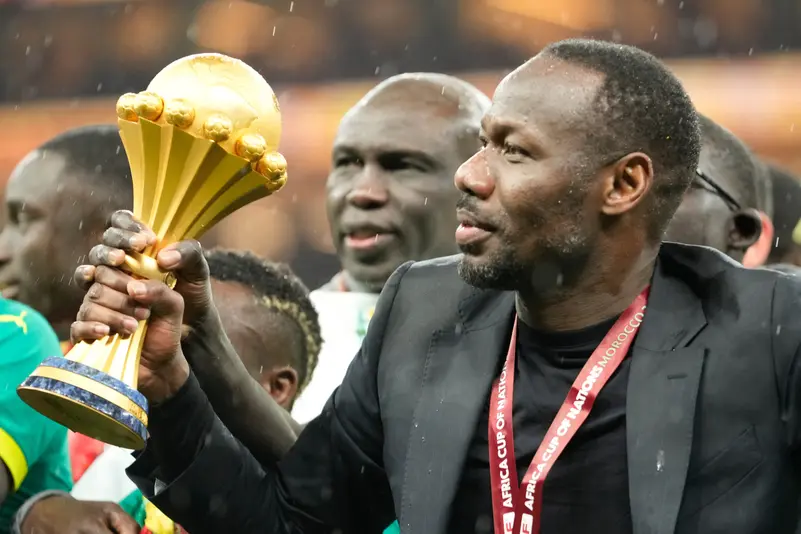
Sadio Mané notably defied Thiaw during the 2025 Africa Cup of Nations (AFCON) final against Morocco, convincing his teammates to return to the pitch after the manager had instructed them to walk off.
The pressure mounted following Senegal’s disappointing campaign at the 2026 World Cup. After a 3-1 defeat to France and a 3-2 loss to Norway, Senegal secured a 5-0 victory against Iraq to advance. However, the Teranga Lions suffered a dramatic 3-2 extra-time elimination against Belgium in the Round of 32, despite holding a 2-0 lead until the 85th minute.
Thiaw faced sharp criticism for his late substitutions against Belgium, particularly removing Pape Gueye and Habib Diarra, which disrupted the team’s balance. His post-match statement that the changes were requested by exhausted players further strained locker room relationships.
Severe Financial Risk for the FSF
Despite the recent turbulence, Thiaw’s overall record stands at 20 wins, 4 draws, and 5 losses. He previously guided the home-based squad to the African Nations Championship (CHAN) title and won the 2025 AFCON final with the senior team—a title that was later stripped following the brief walkout incident against Morocco.
If the FSF insists on terminating Thiaw’s deal, the Ministry’s refusal leaves the federation solely responsible for honoring the financial terms out of its own reserves.
Under the contract’s buyout clause, early termination requires a severance payment equivalent to 8 months of salary, totaling 240 million CFA francs—a heavy financial burden that may force the federation to rethink its position.