


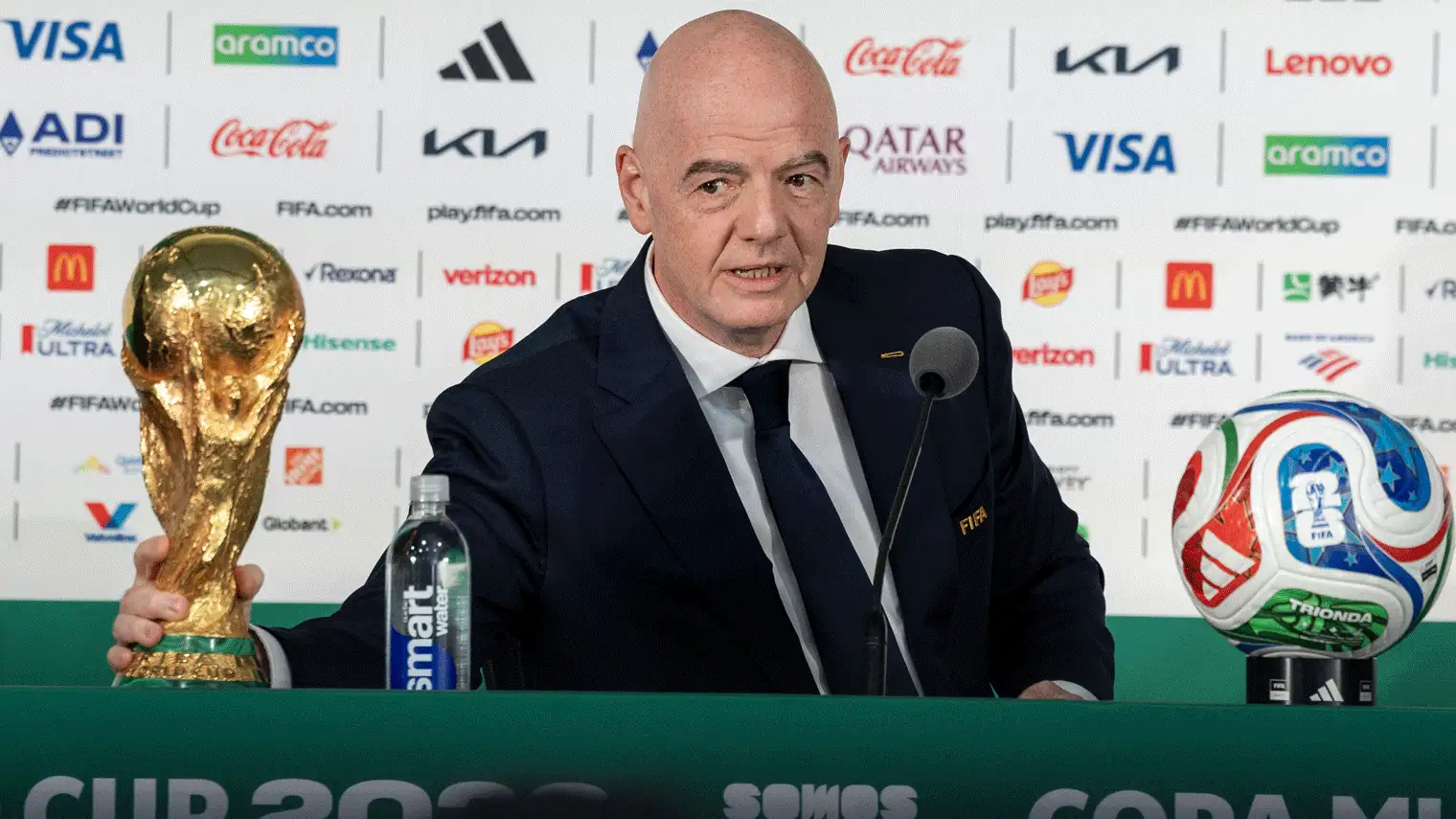
The crisis within the International Association Football Federation (FIFA) has escalated to an unprecedented level after UEFA, the Asian Football Confederation (AFC), and CONCACAF sent a strongly worded joint letter to FIFA. In the letter, they accused the leadership of deception and committing a “fundamental failure of judgment” regarding the “FIFA Forward Enterprise” project.
The letter was signed by UEFA President Aleksander Čeferin, AFC President Sheikh Salman bin Ebrahim Al Khalifa, and CONCACAF President Victor Montagliani. They demanded a fully independent review of the matter, with absolutely no involvement from FIFA management or staff.
Although the letter did not explicitly demand Gianni Infantino’s resignation, informed sources confirm that the three confederations want him out. They are offering him a chance to leave his post with dignity by choosing not to run in the FIFA presidential elections scheduled for next March.
Three Confederations Accuse FIFA Leadership of Deception
The letter emphasized that football does not belong to a specific individual or institution, but rather to the players, fans, clubs, national associations, and all parties entrusted with protecting the game’s future.
-
A Breach of Duty: “When trust collapses due to deception, and when an individual places himself above the collective that granted him power, he has abandoned his duty,” the letter stated.
-
Rejecting Excuses: The three confederations rejected FIFA’s attempt to portray the crisis as a mere “communication failure.” They argued that rushing the project on a tight timeline without genuine consultation, while pressuring national associations for a quick decision, was a deliberate design to limit scrutiny.
-
Fundamental Breach of Trust: The attempt to sell a stake in the World Cup to private investors was described as a “fundamental breach of trust” rather than a procedural error, with a strong demand to preserve all documents and records related to the project.
The letter also pointed out that a recent leadership meeting in Morocco was not attended by a single FIFA Council member or national association representative, but was restricted to a select few senior staff members—a move the confederations view as a continuation of a unilateral management style.
Boycotting FIFA Tournaments and Creating Alternatives
Information circulating within the circles of the three confederations confirms that all options remain on the table if Infantino refuses to step down, including boycotting competitions organized by FIFA.
Preliminary discussions have already begun regarding the possibility of organizing joint tournaments between Europe, Asia, and North/Central America and the Caribbean. This would ensure that national teams and players continue to participate in international competitions while a solution to the crisis is sought.
The letter clarified that this movement does not aim to reverse decisions on tournament expansion, reconsider the hosting of the 2030 and 2034 World Cups, or halt funding to national associations, affirming that these decisions were made collectively and will remain intact.
European Clubs Join Čeferin’s Front
The stance of the three confederations has also garnered support from the European Football Clubs organization (EFC). While the EFC does not hold voting rights in FIFA presidential elections, it represents over 850 clubs and wields massive influence over the future of international competitions.
EFC Chairman Nasser Al-Khelaifi is scheduled to meet with Čeferin this week in Salzburg, amid the UEFA President’s desire to persuade clubs to withdraw their support for the 2029 Club World Cup.
The 2029 edition currently lacks a host venue or a finalized funding model. Furthermore, several clubs are expressing anger over the failure to settle certain direct payments and solidarity allocations tied to the 2025 edition.
The three confederations concluded their letter by asserting that football’s strength has always been in its unity, demanding leadership that “serves the game rather than seeking to control it.”